Looking at the district with a 30,000-foot view can inspire administrators or make them perspire.
Review the Organizational Chart
Start the process by looking at your district/school organizational chart. Is it up to date? If it is not current, adjust the chart to reflect current operations.
While reviewing/reorganizing the chart, look at the fluidity of the connections. Are there too many levels of who reports to whom? Can some departments be combined or even eliminated? Are there departments that may need to be split between two supervisors rather than one due to current events or adjusted due to changes in curriculum? Open a discussion among the administrative team members regarding what works and what doesn’t work specific to the hierarchy.
Walk the Walk
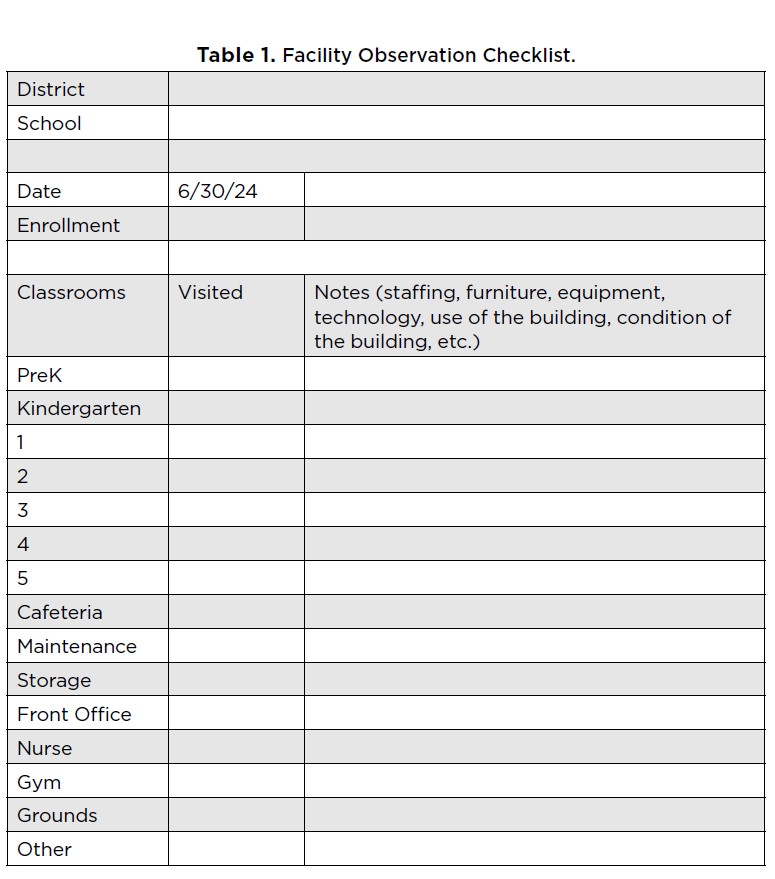
Visit every room in every building in your district. See Table 1 for a checklist of items to note. Pay attention to office furniture, technology, filing cabinets, cleaning equipment, and storage space. Look at the front entrances to determine if they provide security for staff and students while still being welcoming. Talk to the staff in the building about what they believe can be done to make the school year/workday run smoother. Don’t ignore any suggestions, no matter how “out there” they are.
After the walkthrough, discuss and document the SWOT analysis. These results will become the framework for the strategic plan.
Build the Plan
Looking at the district with a 30,000-foot view can inspire administrators or make them perspire. Go back to the goal and look at the data.
Issue: Low Enrollment. Would redistricting be beneficial? Equity, transportation, and classroom size all play a part in this equation. Obtaining community input while in the development stages is crucial to the success of such a plan. If the redistricting leaves a building empty, this may branch off to another part of the analysis to determine what to do with the empty building: sell, keep, rent, or renovate (back to the referendum question).
Issue: Too many people; not enough jobs. Discussions regarding work hours, work year, and workload, while uncomfortable, are important at least every three years—more often, depending on the growth/decline of the population in the district.
Additional conversations should examine how technology is changing the workplace. The district may need to hire more technology staff rather than support staff. A win-win would be if the district encouraged and financially supported staff members’ professional development to enhance their jobs, such as technology.
The same is true for faculty members. If the district financially supports teachers obtaining additional certifications, such as Teaching English to Foreign Learners (TEFL) or Reading Specialist Certification, the district will be able to ensure those educators’ full schedules and not need to reduce their contract.
The easy fix is when a long-term employee leaves and the decision is made to combine their job with an existing position.
Issue: Contract out or keep in-house. If applications for support staff positions are dwindling, it might be prudent to contract out the services. While the district may resolve a financial issue, the district may lose its “family” reputation. Determining well ahead that as in-house personnel leave, the replacement will be contracted personnel may reduce the sting.
Executive Summary
The results of the strategic analysis may elicit some surprises; be prepared. On the other hand, the results may give the district a solid three- to five-year plan that can be presented to the board and community with the common goal of being prepared.
Students are always the priority; however, the driving force here is to make sure all essential employees (i.e., every staff member in the district) have the right tools, working environment, and support system to succeed.
Business officials wear many hats every day. Being able to properly plan, focus, and help move the district into the future with as little drama as possible is an opportunity to use the training and experience obtained in this amazing challenging profession.